
- Most Highly Rated
470+ google reviews - Top Rated Reviews



Last Update
If you have been keeping an eye on developments regarding Australian work visas, you have likely heard about the 482 visa undergoing a significant makeover. The Skills in Demand visa replaced the Temporary Skill Shortage visa on 7 December 2024. Further changes to English testing commenced on 13 September 2025, and the relevant income thresholds increased again on 1 July 2026.
There is new jargon, such as the Skills in Demand visa, new minimum pay levels, new English test options, and changes affecting certain pathways to permanent residency.
Is it very intricate? Don’t worry; this guide explains the principal changes. If you are a holder of a 482 visa at the moment or are planning to apply soon, you may be wondering how the current rules affect your situation.
Let’s start with the headline change. On 7 December 2024, the Skills in Demand visa replaced the Temporary Skill Shortage (TSS) visa.
This is not an entirely new visa subclass. The subclass number 482 remains the same, but the structure and some eligibility requirements have changed.

The Skills in Demand visa was introduced as part of the Australian Government’s skilled-migration reforms.
One objective was to create a system that responds more effectively to Australia’s workforce needs.
Another was to provide updated visa pathways for employers seeking to sponsor appropriately skilled overseas workers when they cannot find a suitably skilled Australian worker.

The former Short-Term and Medium-Term streams were replaced for new applications by the Core Skills and Specialist Skills streams. A Labour Agreement stream also remains available for workers nominated under an applicable labour agreement.
If your application or associated nomination was lodged before 7 December 2024, transitional arrangements may apply. The applicable rules depend on the date and type of application or nomination. If you apply now, you will generally be assessed under the Skills in Demand visa rules.
Talk to one of our Visa Experts Now.
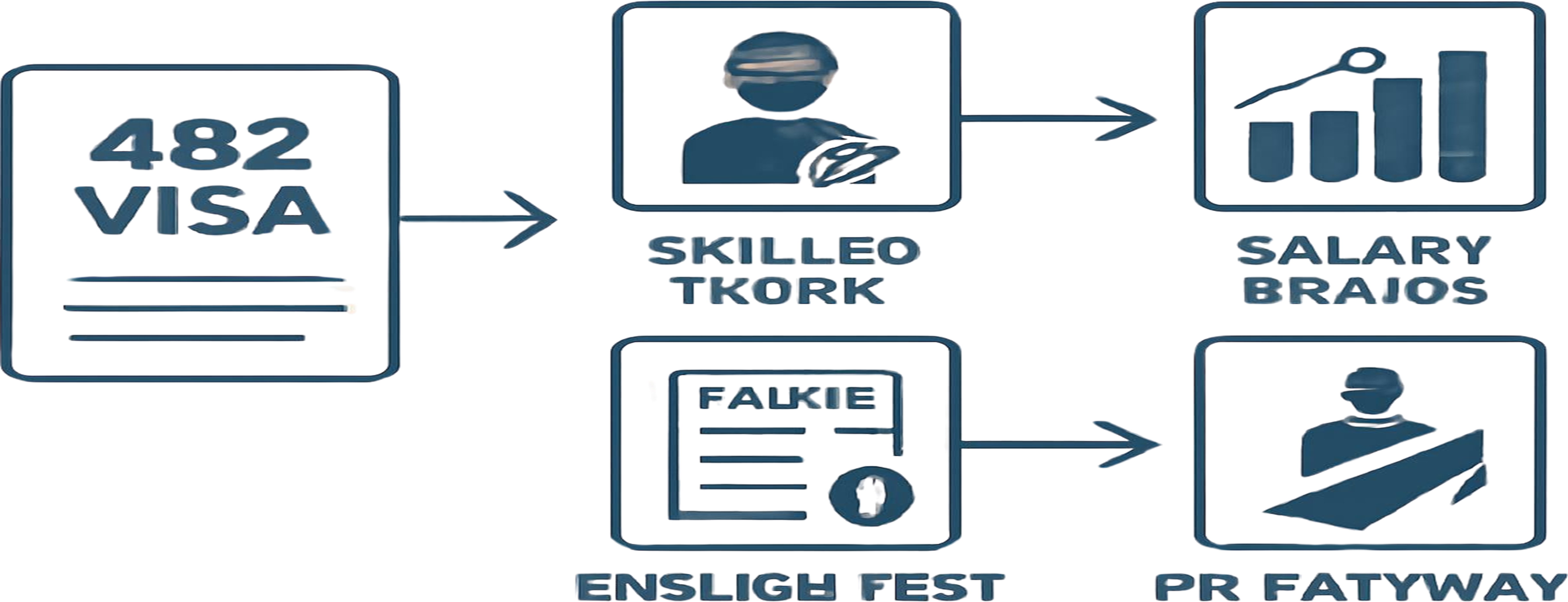
The Skills in Demand framework replaced the former Short-Term and Medium-Term streams. Eligibility now depends on factors including the nominated occupation, salary, employer sponsorship, work experience, skills and the requirements of the relevant stream.
Target group: Highly skilled workers in eligible occupations whose nominated salary meets the Specialist Skills Income Threshold.
For nomination applications lodged from 1 July 2026 to 30 June 2027, the Specialist Skills Income Threshold is AUD146,576.
Processing time: Processing times vary. Applicants should check the Department of Home Affairs visa processing-time guide. Published processing times are estimates and are not guarantees.
Occupations: The nominated occupation must fall within ANZSCO Major Group 1, 2, 4, 5 or 6. Occupations in Major Groups 3, 7 and 8 are excluded from this stream.
The applicant must also have the skills required for the nominated occupation, generally have at least 12 months of relevant work experience, meet the applicable English requirement and satisfy the other visa criteria.
Permanent residency: Eligible subclass 482 holders may subsequently qualify for an employer-sponsored permanent visa, such as the subclass 186 Temporary Residence Transition stream. Completing two years of eligible sponsored employment is one requirement of that pathway, but it does not automatically provide permanent residence.
There is no current annual quota of exactly 3,000 published on the Department of Home Affairs Specialist Skills stream page.
Who it’s for: Skilled workers whose nominated occupation appears on the Core Skills Occupation List and whose salary meets the applicable requirements.
For nomination applications lodged from 1 July 2026 to 30 June 2027, the Core Skills Income Threshold is AUD79,423.
The worker must also be paid at least the applicable Annual Market Salary Rate. The nomination must satisfy both the market-salary and income-threshold requirements.
Processing time: Processing times vary and should be checked using the Department of Home Affairs visa processing-time guide.
Occupation list: The applicant’s nominated occupation must be an occupation specified for the Core Skills stream on the Core Skills Occupation List.
Permanent residency: An eligible subclass 482 holder may be able to apply under the subclass 186 Temporary Residence Transition stream after completing at least two years of eligible sponsored employment during the three years immediately before applying. Nomination, age, visa status, skills and all other applicable requirements must also be met.
Nurses, engineers, IT professionals, plumbers and accountants may include occupations that are eligible for skilled migration. However, eligibility must always be checked against the exact ANZSCO occupation and the requirements of the relevant stream. A broad professional title does not confirm visa eligibility.
Example: You are a senior consultant or architect earning at least AUD146,576. You may be considered for the Specialist Skills stream if your nominated occupation falls within an eligible ANZSCO Major Group and you meet the sponsorship, skills, work-experience, English and other visa requirements. Salary alone does not make a person eligible.
Who it’s for: Skilled workers nominated by an employer that has an applicable labour agreement with the Australian Government.
Labour agreements may be used where standard skilled-visa arrangements do not adequately meet an employer’s workforce needs. They can include industry, company-specific or Designated Area Migration Agreements.
Salary and occupation requirements: These depend on the terms of the applicable labour agreement and Australian migration law.
Permanent-residence pathway: Some labour agreements may provide access to an Employer Nomination Scheme visa pathway. This depends on the terms of the relevant agreement and the applicant meeting all applicable requirements.
There is currently no general Essential Skills stream listed as an operating stream of the Skills in Demand visa. Earlier government policy documents proposed consultation on arrangements for workers with essential skills, but this should not be presented as an available general visa stream.
Workers and employers in aged care, disability support, hospitality and other sectors should check whether an applicable occupation, industry labour agreement or other visa option is available.
Talk to one of our Visa Experts Now.
The Skills in Demand visa income thresholds increased again on 1 July 2026 in line with changes to Average Weekly Ordinary Time Earnings.
For nomination applications lodged between 1 July 2026 and 30 June 2027:
If your proposed salary is below the applicable threshold, your employer may need to reconsider the remuneration package or the proposed nomination.
The applicable threshold is ordinarily determined by the date the employer’s nomination application is lodged—not simply the date the worker’s visa application is submitted.
For historical comparison:
The thresholds were subsequently indexed on 1 July 2026.
Keep in mind that these salary thresholds are minimum requirements. Where the proposed annual salary is below AUD250,000, the employer must correctly determine the Annual Market Salary Rate, must not pay the overseas worker less than an equivalent Australian worker and must ensure that both the market salary rate and the worker’s pay, excluding non-monetary benefits, meet the applicable income threshold.
These requirements are designed to prevent overseas workers from being paid less than Australian workers performing equivalent work.
Updated English requirements for subclass 482 visa applications commenced on 13 September 2025.
The approved English tests include:
Applicants must obtain the prescribed component scores for the relevant test and comply with the testing requirements in the applicable legislative instrument.
You cannot combine component scores from different English tests. For example, an IELTS speaking score cannot be combined with a PTE writing score.
The required component results must be obtained through an approved test taken on a particular test day.
Generally, the approved English test must have been undertaken no more than three years before the visa application. Transitional provisions and exemptions may apply in particular circumstances.
The expanded range of approved tests provides applicants with more testing options. However, every applicant must still satisfy the prescribed scores and testing conditions for the relevant visa stream.

Eligible subclass 482 visa holders may be able to progress to permanent residence through the Employer Nomination Scheme subclass 186 Temporary Residence Transition stream.
However, a subclass 482 visa does not automatically guarantee permanent residence.
The employment-period requirement for the subclass 186 Temporary Residence Transition stream was reduced from three years to two years from 25 November 2023.
An applicant must generally have completed at least two years of eligible sponsored full-time employment in Australia during the three years immediately before applying.
This is only one requirement. Applicants must also meet the employer-nomination, visa-status, age, skills and other applicable criteria.
Eligible former TSS and current Skills in Demand visa holders may be able to access the subclass 186 Temporary Residence Transition stream if they satisfy its requirements.
Applicants under a Labour Agreement stream must consider the terms of the relevant agreement and the requirements of the applicable permanent-visa stream.
If an applicant has held multiple subclass 457 or 482 visas during the relevant three-year period, sponsored employment may be counted in any occupation the applicant was approved to perform.
If an applicant has changed employers, sponsored employment with the new employer may potentially be counted from the date an approved nomination was lodged, provided the applicable conditions are met.
However, the subclass 186 applicant must generally be nominated by the employer that most recently sponsored them. Changing jobs or occupations should therefore be considered carefully.
Subclass 186 Temporary Residence Transition applicants must usually be under 45 years of age when they apply.
Specified exemptions may apply to certain academics, researchers or technical specialists, regional medical practitioners and eligible high-income workers. Each exemption has detailed requirements and should be assessed individually.
There is no fixed total timeframe for permanent residence.
A possible pathway may involve:
The total timeframe depends on when eligible employment begins, the applicant’s circumstances, nomination timing, document readiness, processing times and whether all legislative requirements are met.
At Parish Patience Immigration Lawyers, we assist clients with changing migration requirements, including the transition from the Temporary Skill Shortage visa to the Skills in Demand visa.
Schedule a consultation to discuss how the current subclass 482 and Skills in Demand visa requirements may affect you or your business.
Indeed, the changes to the 482 visa in 2026 have introduced more challenges, yet at the same time, they have set up new possibilities.
The new name, Skills in Demand, the three-level system, increased minimum salaries, adaptable English tests, and quicker PR changes all point to one conclusion: Australia is looking for and keeping real talent.
If you are encountering this system for the first time, get help. Parish Patience Immigration Lawyers can guide you through every alteration and turn it to your benefit.
 Step‑by‑Step: How to Apply for Australian Citizenship in 2026 September 9, 2026
 Can Australian Citizenship be Revoked? August 18, 2026
 Benefits of Australian Citizenship August 23, 2025


