
- Most Highly Rated
470+ google reviews - Top Rated Reviews



Last Update
The good news is that you cannot lose your permanent residency just because you are in a foreign country. But knowing this will not make it easier for you to maintain your Australian permanent residency while staying abroad. Many PR holders worry that they will automatically lose their status if they are away from the country for an extended period. We can understand why it isn’t very clear. The main reason is that people often confuse “permanent residency” with “travel facility.” They are two distinct things. Let’s go through what exactly is happening, what your choices are, and how to safeguard your PR while you are on holiday or living abroad. At Parish Patience, you can rely on us to guide you through all this with great comfort.
One of the most common misconceptions about permanent residency is that it is forever, no ifs or buts. However, it is more like a grant of two rights to you when it is granted.
Your first right is to stay in Australia for as long as you want; that part is indeed permanent. Your second right is to return to Australia, and the permit is valid for only 5 years.
If you happen to be in Australia, you can stay here for good as a local. On the other hand, if you travel outside the country, your entry ticket will be valid for only 5 years unless you extend it. Nevertheless, your PR status is still the same; you are a permanent resident in a legal sense, but cannot pass through the arrivals gate without a valid travel facility.
The Resident Return Visa (RRV) is then the solution for you; it is a quick renewal of your travel rights, not your residency.
To illustrate: think of it as if you have a lifetime gym membership, but your keycard will not work after five years. You are still a member, just need a new card to get in.
Talk to one of our Visa Experts Now.
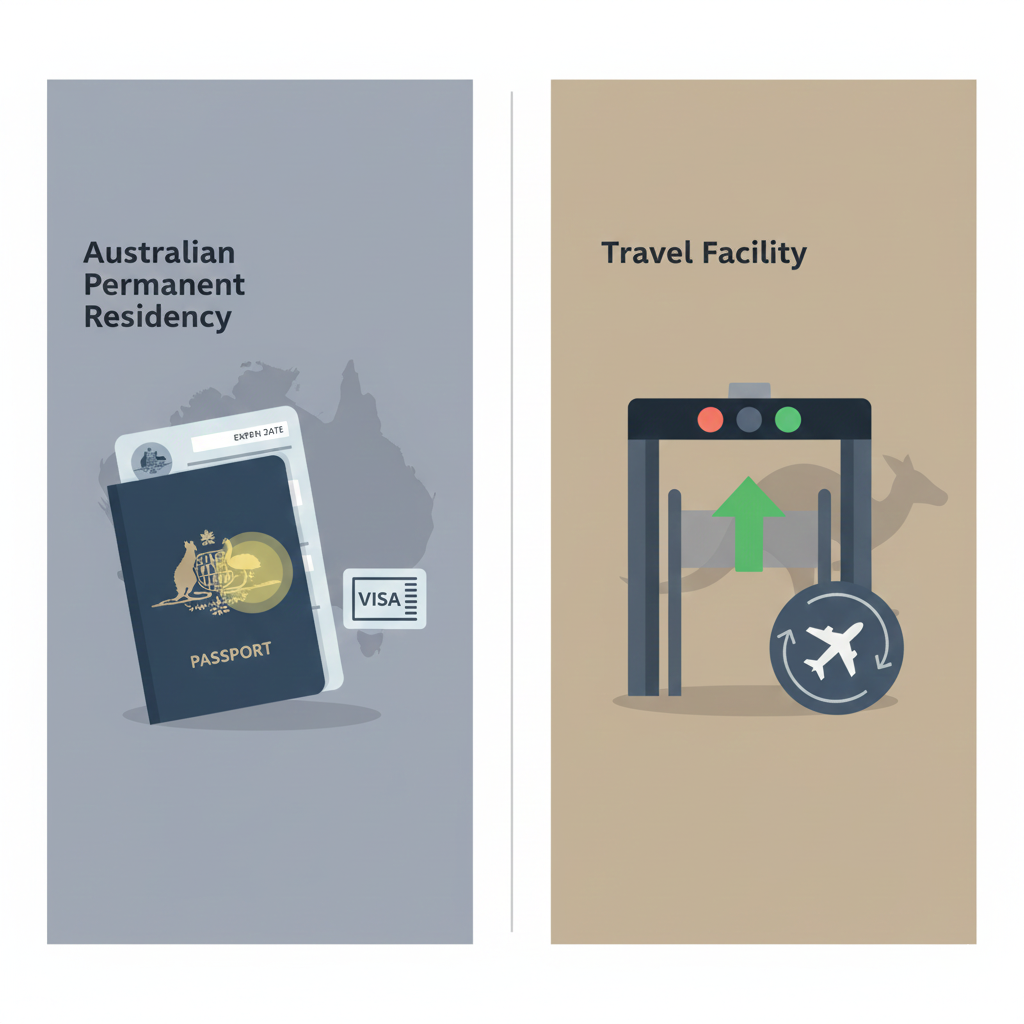
Once you acquire permanent residency, you will, in most cases, be granted a travel facility for 5 years. This will either be noted in your visa grant or visible in your ImmiAccount. The following is how the process runs:
Actual case: If your PR was granted on January 1, 2024, then your travel facility will last until January 1, 2029. You can travel and return as often as you want until that date. However, if you are still outside Australia on January 2, 2029, and try to return, you will need a Resident Return Visa (RRV) to enter as a permanent resident.

Let’s look at the scenarios:
Scenario 1: Your travel facility expires while you are in Australia.
No worries. You are already in, and you will remain a PR. The only thing is that you will not be able to leave and expect to return to the same facility.
Scenario 2: Your travel facility expires while you are outside Australia.
This is the point where everything counts. PR status is still there, but the travel facility has expired. You cannot enter Australia as a permanent resident unless you first get a valid RRV. Travelling on a visitor visa? It is possible, but you will be a visitor, not a PR for that entry.
Scenario 3: You have been overseas for 3, 5, 10+ years.
No, automatic loss of your PR status does not occur. It is, however, in a way, the same as a practical issue. The entry privilege is taken away, and it becomes more of a “paper PR”. You will have a hard time getting an RRV if you were away for a long time and your links to Australia are weak.
Bottom line: Being overseas doesn’t cancel your PR, but it may stop you from using it without some extra steps.
Here’s where the RRV comes in. Think of it as renewing or restoring your travel facility so you can re‑enter Australia as a PR.
An RRV is a visa subclass (usually Subclass 155 or 157) providing a new travel facility. Its application is done in case of travel facilities expiration or when the applicant is away from Australia, or in case the residence requirement has not been met.
Subclass 155 (5-Year RRV):
Subclass 157 (Short-Term RRV):
If you have spent at least 2 years in Australia over the last 5 years, you satisfy the residence condition for the 5-year RRV. Illustration: After receiving PR, you stayed in Australia for 1.5 years, then went abroad for 3 years. You have not complied with the 2-year requirement. You will be required to apply for an RRV that demonstrates your connections to Australia.
Moreover, you have the option to apply for a Resident Return Visa (RRV) by establishing substantial connections with Australia, such as family, business, or cultural ties. Ties are missing; hence, you may only be granted a short-term RRV, or your application might be rejected.
For illustration: You received the PR in 2020, resided in Australia for 1.5 years, and then transferred to another country. Now, after three years in a foreign land, you are not able to meet the 730-day requirement. Your parents reside in Sydney, which means you are still eligible to apply for RRV based on family ties.
Honest tip: The most straightforward solution? Become an Australian citizen once eligible. Then you never have to worry about travel facility expiration.
You should pay attention to:
Solution: Get professional assistance. A few hundred dollars spent on a migration lawyer can prevent you from making mistakes that cost you thousands of dollars.

Parish Patience is known for its expert handling of residency-related issues, including the renewal of travel facilities and RRV applications. They will check your current visa status, give you a clear explanation of your options, and walk you through the RRV process step by step.
If you have any doubts regarding the application of the rules to your personal situation or if you are dealing with family sponsorship while abroad, Parish Patience will offer you personalised and pragmatic guidance.
Call to action:
Book a consultation to go over your PR and travel plans.
Get in touch with Parish Patience Immigration Lawyers right away!
Your PR remains valid irrespective of your residing location; that worry is baseless. What expires is your travel facility, which governs your re-entry to Australia.
The answer? The RRV. Depending on the length of your stay or the degree of your ties with Australia, you can virtually renew your travel facility for many years ahead.
There is no automatic forfeiture of PR, and there are various options to keep your status. Today, take full control of your Australian PR journey. Get in touch with Parish Patience Immigration Lawyers to chat about your travel and residency situation.
Talk to one of our Visa Experts Now.
 Benefits of Australian Citizenship August 23, 2025
 Renouncing Australian Citizenship May 19, 2025
 Australian Citizenship by Conferral November 4, 2024
Our customers are always happy to share their thoughts with us.
Here is what some of them had said!

The team at parish Patience Immigration Lawyers were incredibly helpful throughout the application process. Their assistance made our lives so much less stressful and their expertise cleared up any confusion we had. They remained engaged with us the whole time and quickly responded to any questions with thoughtful, detailed answers. Special thanks to Usman Ali and Shan . We highly recommend the team at Parish patience immigration lawyer for anyone considering help regarding any kind of visa .
Highly recommended lawyers! Extremely professional and reliable service, with outstanding outcomes. A special thanks to Mr Thong and Marlene, for helping us with our difficult case. Not only did they ensure that everything was ready to go, but their professionalism came in favor when we were granted our visa within just under 6 months!
Thong and Marlene helped my partner gain permanent residency in Australia. We did the application ourselves but it turned out lots of information we needed to provide was missing. Thong and Marlene picked our case up and helped amend it. I really appreciate their help and guidance and look forward to contacting them again in the future. I am pleased by their efforts and professionalism.
Successfully handled my case. He had been prompt, caring and very professional in dealing with my case. I am glad to have received very strong support, guidance and service from them. I would highly recommend Parish patience immigration lawyers. I wish the best for their future prospects.
I’m really thankful for the guidance and assistance I’ve received regarding my Partner visa from Shan and his assistance Asha at Parish Patience. They handled my matter professionally and there were clear instructions from the beginning till end. I got my partner visa 820 granted in less than 7 months, thanks to their knowledge and expertise. I wish them all the best and highly recommend Parish Patience Immigration Lawyers for any sort of immigration matters.
Parish Patience experts know that applying for Australian PR needs a lot of time and effort. For this reason, we make sure to offer our clients with the highest level of support and guidance throughout the immigration process. We work closely with you to establish specialised strategies that will maximise the chances of visa accomplishment.
Want to make your immigration journey seamless? Become a permanent resident Australia will welcome next with the help of licensed migration experts at Parish Patience! Call our office on 02 9286 8700 or send us an email: ppmail@ppilaw.com.au