
- Most Highly Rated
470+ google reviews - Top Rated Reviews



Last Update
Nursing is among the professions experiencing demand in Australia. If you are an enrolled nurse, you may have several temporary, provisional or permanent visa options, and we will explain the principal pathways.
“Sure, it is possible, but sponsorship is tough. Skills assessment can be a maze. There are a lot of competing paths. What is the timeline?” These are legitimate concerns. However, Enrolled Nurse ANZSCO 411411 is included on relevant skilled occupation lists, and eligible applicants may have migration options.
In this article, we will discuss three principal options: the subclass 482 employer-sponsored visa, state nomination pathways through the subclass 190 and 491 visas, and the ANMAC skills-assessment process that may be required for certain skilled visas. With the right approach, your goal of becoming a permanent resident as an enrolled nurse in Australia may be achievable. At Parish Patience Immigration Lawyers, we can guide you through the process.
Australia has an ongoing need for healthcare professionals. This need can apply not only to registered nurses but also to enrolled nurses.
Enrolled nurses work in hospitals, aged-care facilities, community health services and regional healthcare settings. The Australian Government recognises Enrolled Nurse ANZSCO 411411 on the Core Skills Occupation List for the subclass 482 Skills in Demand visa. The occupation may also be available for certain points-tested and state-nominated visa pathways.
This can be good news for eligible applicants. Some aged-care facilities and other healthcare employers may consider sponsoring enrolled nurses. However, sponsorship depends on the employer, the position, the proposed salary and the applicant satisfying all relevant visa and registration requirements.
Some sponsored enrolled nurses may later become eligible for permanent residence. However, neither sponsorship nor permanent residence is guaranteed, and processing times vary between applications.
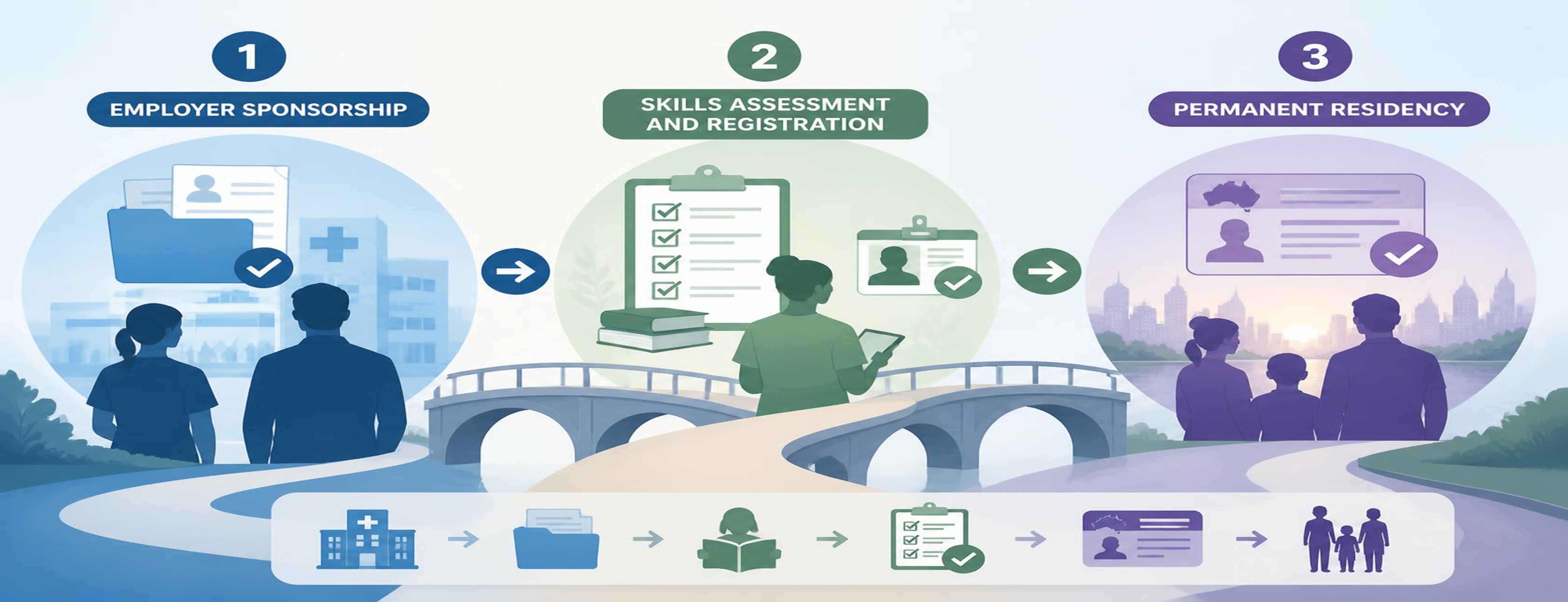
The following visa options may be relevant to enrolled nurses. The most suitable pathway depends on your qualifications, registration, skills assessment, work experience, points, employer and personal circumstances.
You receive a genuine job offer from an Australian employer willing and able to sponsor you as an enrolled nurse.
The employer must be an approved sponsor or apply to become one and nominate an eligible Enrolled Nurse position for the subclass 482 Skills in Demand visa.
For a Core Skills nomination lodged between 1 July 2026 and 30 June 2027, the proposed salary must meet the Core Skills Income Threshold of AUD79,423. The worker must also be paid at least the correctly determined Annual Market Salary Rate.
You must generally have at least 12 months of relevant work experience and satisfy the skills, English, health, character, registration and other applicable visa requirements.
After completing the required period of eligible sponsored employment, you may be able to apply for the subclass 186 Employer Nomination Scheme visa through the Temporary Residence Transition stream.
An applicant must generally have completed at least two years of eligible sponsored full-time employment in Australia during the three years immediately before applying for the subclass 186 visa.
Two years of work is only one requirement. You must also have an eligible employer nomination and satisfy the relevant age, English, visa-status, skills, registration, health, character and other requirements.
You will generally need:
The English requirement for the subclass 482 visa is different from the English standard for nursing registration.
For subclass 482 applications subject to the current English instrument, IELTS generally requires an overall score of at least 5.0 and at least 5.0 in each component, unless an exemption applies. Equivalent requirements are prescribed for other approved tests.
To obtain initial nursing registration, an applicant must separately satisfy the current NMBA English language skills registration standard. Under the test pathway, the current IELTS Academic requirement is generally an overall score of 7, with at least 7 in listening, reading and speaking and at least 6.5 in writing.
Other approved English tests and alternative English-language pathways may be available. Applicants should check the current NMBA/Ahpra requirements because test scores, combination rules and transition arrangements can change.
There is no fixed timeframe for obtaining an enrolled-nurse job offer or employer sponsorship.
Subclass 482 processing times vary and should be checked using the Department of Home Affairs visa processing-time guide.
An applicant must then complete the applicable period of eligible sponsored employment before applying for the subclass 186 Temporary Residence Transition stream.
Subclass 186 processing times also vary. A two-to-three-month decision period should not be assumed or guaranteed.
“Ngozi, an enrolled nurse from abroad, is hired by an aged-care facility in NSW. The employer successfully sponsors her for a subclass 482 visa. After completing at least two years of eligible sponsored employment, her employer may nominate her for a subclass 186 visa. Ngozi must still satisfy all applicable subclass 186 requirements.”
There is no guaranteed total timeframe. Recruitment, registration, sponsorship, nomination, eligible employment and visa processing can all affect the outcome.
If you prefer a direct permanent visa and meet the applicable requirements, the subclass 190 Skilled Nominated visa may be an option.
First, check whether an Enrolled Nurse is eligible under the relevant skilled-occupation and state or territory requirements.
You will generally need to obtain a suitable ANMAC skills assessment and submit an Expression of Interest through SkillSelect.
A state or territory government agency may then select and nominate you under its own nomination process.
If nominated, you may receive an invitation to apply for the subclass 190 Skilled Nominated visa.
Meeting 65 points does not guarantee state nomination or an invitation. State and territory governments apply their own criteria and priorities, and competitive applicants may need more than the federal minimum.
State nomination requirements and occupation availability change regularly. Applicants should check the official migration website of the relevant state or territory before relying on a particular pathway.
Advantage: The subclass 190 visa is a permanent visa if granted, so it does not involve a provisional visa period.
Duration: There is no fixed six-to-twelve-month timeframe. The total period depends on the skills assessment, state selection, nomination, invitation and federal visa-processing stages.
If you are open to living and working in a designated regional area, the subclass 491 Skilled Work Regional visa may be an option.
The subclass 491 visa is also points tested. Applicants must generally score at least 65 points. State or territory nomination or sponsorship by an eligible relative provides 15 points, but the applicant must still satisfy the points threshold and all other criteria.
You submit an Expression of Interest through SkillSelect.
A state or territory government agency may nominate you, or an eligible relative may sponsor you.
You must receive an invitation before applying for the subclass 491 visa.
If granted, you must comply with the visa conditions applying to living, working and studying in a designated regional area.
After holding an eligible regional provisional visa for at least three years, you may be able to apply for the subclass 191 Permanent Residence (Skilled Regional) visa.
For the subclass 191 Regional Provisional stream, applicants must generally:
There is currently no minimum taxable-income amount for this subclass 191 requirement.
Most suitable for: Nurses who are open to living and working in designated regional areas and who satisfy the nomination, points, skills-assessment and visa requirements.
Talk to one of our Visa Experts Now.
The subclass 482 pathway may be suitable for enrolled nurses who have an eligible employer willing to sponsor them. Below is the step-by-step process.
A potential sponsor might be an aged-care facility, hospital or community health service with a genuine Enrolled Nurse position.
A disability-services provider could only sponsor a person as an enrolled nurse if the offered position genuinely corresponds to the duties and skill level of that occupation.
You may need to present:
A Diploma of Nursing alone does not establish visa or registration eligibility, particularly where the qualification was completed overseas.
The employer must be an approved Standard Business Sponsor or apply to become one. It must then nominate a genuine enrolled-nurse position and satisfy the relevant labour-market testing, salary and nomination requirements.
Employer expenses can include sponsorship and nomination charges and the Skilling Australians Fund levy. The total depends on matters including the employer’s annual turnover and the proposed visa period.
There is no guaranteed two- to four-week processing period. Sponsorship and nomination processing times vary.
You apply for the subclass 482 Skills in Demand visa in connection with the employer’s nomination.
Depending on your circumstances, supporting evidence may include:
A positive ANMAC assessment is not a universal requirement for every enrolled nurse applying for a subclass 482 visa. The requirement should be checked for the individual application.
Visa application charges change periodically and depend on whether family members are included. Applicants should use the current Department of Home Affairs visa-pricing estimator.
Healthcare occupation priority does not guarantee faster processing. Use the official visa processing-time guide for current estimates.
Work in accordance with the conditions attached to your visa and the approved nomination.
Primary subclass 482 holders are generally subject to restrictions concerning their sponsoring employer and nominated occupation. Check your visa grant letter and VEVO for the conditions that apply to you.
After completing the required period of eligible sponsored employment, an eligible employer may nominate you for a subclass 186 visa.
The employer is not legally required to provide a permanent-residence nomination merely because it previously sponsored you for a subclass 482 visa.
You must submit a separate subclass 186 visa application and meet all applicable requirements. A compliant employment history does not guarantee nomination or visa approval.
If we look at the procedure as a whole, there is no reliable fixed timeframe:
The principal advantage of this pathway is that eligible subclass 482 holders may have access to the subclass 186 Temporary Residence Transition stream. Unlike a points-tested visa, subclass 186 TRT does not depend on receiving a SkillSelect invitation.
However, it is not a certain or automatic PR pathway. Two years of eligible sponsored employment satisfies only one part of the subclass 186 requirements.
ANMAC is the government-approved assessing authority for nursing and midwifery occupations for relevant skilled-migration applications.
ANMAC is not a visa pathway and does not decide whether a visa will be granted. It assesses whether an applicant’s skills and qualifications are suitable for migration purposes.
The applicable requirements depend on the assessment type. Current ANMAC assessment options include:
Most nurses and midwives intending to migrate will need to obtain NMBA registration before applying for a Modified Skills Assessment.
You may need to provide:
Character references should not be described as a standard identity requirement unless ANMAC specifically requests them.
English test evidence is required for a Full Skills Assessment, but it is not necessarily required for every ANMAC assessment type.
ANMAC’s English requirements should not be confused with:
Applicants should check the current ANMAC criteria for their assessment type and the current NMBA/Ahpra accepted-test table.
For nursing registration through the test pathway, the current IELTS Academic standard is generally:
Equivalent requirements apply to other approved tests, including OET, PTE Academic and TOEFL iBT. Minimum scores and transition rules have changed, so applicants should use the current official table rather than relying on older figures such as PTE 65 in every component.
Some applicants may satisfy the NMBA English standard through a primary-language or recognised-education pathway without sitting an English test.
ANMAC reviews education and training evidence as part of the migration skills assessment.
Depending on the assessment type, it may examine:
The NMBA and Ahpra determine eligibility for nursing registration. ANMAC assesses skills for migration purposes. These are separate processes.
If you completed an NMBA-approved Australian program of study, you may be eligible to apply for registration. Registration and migration eligibility are not automatic.
If you studied abroad, your qualifications, registration and other evidence will be assessed against the applicable requirements. Providing complete documents does not guarantee recognition.
Work-experience requirements depend on the ANMAC assessment type and whether you want your employment assessed for visa eligibility or points.
Evidence may include:
There is no universal rule that every ANMAC applicant must prove nursing employment during the previous five years. Applicants should follow the current checklist for their assessment category.
ANMAC applies specific document requirements. Depending on the assessment type, documents may include:
Documents must comply with ANMAC’s current format, resolution, translation and verification requirements.
The assessment process is more likely to proceed efficiently when documents are complete, readable and capable of verification.
Talk to one of our Visa Experts Now.
| Situation | Subclass 190 Visa | Subclass 491 Visa |
| You want direct permanent residence | ✓ Permanent visa if granted | ✗ Provisional visa with a potential pathway to subclass 191 |
| You don’t have a job offer | ✓ A job offer is not universally required, but state criteria vary | ✓ A job offer is not universally required, but state criteria vary |
| You have at least 65 points | ✓ Minimum requirement; invitation is not guaranteed | ✓ Minimum requirement; nomination provides 15 points |
| You do not want to be tied to one employer | ✓ Not an employer-sponsored visa; state commitments may apply | ✓ Not tied to one employer, but regional visa conditions apply |
| You want a direct PR outcome | ✓ Direct PR if the visa is granted | ✗ Generally requires at least three years on an eligible regional provisional visa before subclass 191 |
| You are comfortable with a regional commitment | Not inherently required by the visa, but state nomination conditions should be checked | ✓ Must comply with applicable designated-regional-area conditions |
| Points category | Points available |
| Age 25–32 | 30 points |
| Proficient English, for example, IELTS 7 in each component | 10 points |
| Superior English, for example, IELTS 8 in each component | 20 points |
| Recognised diploma or trade qualification | 10 points |
| Recognised bachelor’s degree or higher qualification | 15 points |
| Recognised doctorate | 20 points |
| Overseas skilled employment, at least 3 but under 5 years | 5 points |
| Overseas skilled employment, at least 5 but under 8 years | 10 points |
| Overseas skilled employment, at least 8 years | 15 points |
| Australian skilled employment, at least 1 but under 3 years | 5 points |
| Australian skilled employment, at least 3 but under 5 years | 10 points |
| Australian skilled employment, at least 5 but under 8 years | 15 points |
| Australian skilled employment, at least 8 years | 20 points |
| Subclass 190 state or territory nomination | 5 points |
| Subclass 491 nomination or eligible-family sponsorship | 15 points |
| State or territory | Verified position | Important qualification |
| South Australia | Enrolled Nurse appears under the South Australian DAMA | DAMA is an employer-sponsored arrangement, not the same as subclass 190 or 491 nomination. Previous SA nomination rounds reported more Enrolled Nurse interest than available places. Check current GSM eligibility before applying. |
| Tasmania | Enrolled Nurse appears among occupations recognised under Tasmania’s Skilled Employment priority-role arrangements | Applicants must satisfy the relevant Tasmanian pathway. Priority-role status does not guarantee selection or nomination. |
| Western Australia | Enrolled Nurse has appeared in WA nomination and invitation information, and healthcare and social assistance has been treated as a priority industry sector. | WA invitation scores and priorities vary between rounds. Historical invitation results should not be presented as current thresholds. |
| Northern Territory | Enrolled nurses may be considered where they meet the applicable NT nomination pathway and federal occupation requirements | Eligibility depends on factors such as NT residence, employment, family connection, a qualifying job offer or the applicable offshore occupation list. Nomination is discretionary. |
| Feature | Detail |
| Visa type | Five-year regional provisional visa |
| Nomination or sponsorship | Requires state or territory nomination or sponsorship by an eligible relative |
| Points requirement | At least 65 points, including 15 points for subclass 491 nomination or eligible-family sponsorship |
| Regional conditions | Visa holder must comply with the applicable conditions concerning living, working and studying in a designated regional area |
| Potential PR pathway | Eligible applicants may apply for the subclass 191 visa after holding an eligible regional provisional visa for at least three years and meeting all applicable requirements |
| Subclass 191 income evidence | Three relevant ATO notices of assessment are generally required; there is currently no minimum income amount |
| May suit | Eligible applicants willing to make a regional commitment and able to obtain nomination or eligible-family sponsorship |
| Factor | Subclass 482 → 186 TRT | Subclass 190 | Subclass 491 → 191 |
| Initial visa type | Temporary employer-sponsored visa | Permanent visa | Five-year regional provisional visa |
| Potential PR timing | Subclass 186 TRT generally requires at least two years of eligible sponsored employment; total timing varies | Permanent residence begins if and when subclass 190 is granted; nomination and processing times vary | Subclass 191 may be available after holding an eligible regional provisional visa for at least three years; total timing varies |
| Job offer | A genuine sponsored position is required | Not universally required by federal rules; state criteria vary | Not universally required by federal rules; state criteria vary |
| Points test | Not points tested | At least 65 points, including five nomination points | At least 65 points, including 15 nomination or eligible-family sponsorship points |
| Skills assessment | Depends on the visa stage and applicant’s circumstances | Suitable skills assessment required | Suitable skills assessment required |
| PR certainty | Not guaranteed; employer nomination and all subclass 186 criteria must be met | Not guaranteed until the visa is granted | Not guaranteed; subclass 191 requirements must be met |
| Employment flexibility | Generally subject to sponsor, occupation and visa conditions | Not employer-sponsored; state nomination commitments should be observed | Not tied to one employer, but regional conditions apply |
| May suit | Applicants with an eligible employer willing to sponsor them | Applicants able to obtain state nomination and an invitation for direct PR | Applicants willing to make a regional commitment and able to obtain nomination or eligible-family sponsorship |

At Parish Patience Immigration Lawyers, we assist with healthcare-related migration matters, including applications involving enrolled nurses and potential subclass 482-to-186 pathways.
We can assist you by:
Any employer introductions or recruitment-related assistance will depend on the services available and the circumstances of the matter.
If you are ready to consider nursing and migration options in Australia, we can help you understand the requirements and possible next steps.
Book a consultation to discuss the visa pathways that may be available to you as an enrolled nurse.
If you are an enrolled nurse, you may have several migration options. These can include employer sponsorship, state nomination and regional skilled migration.
The appropriate enrolled nurse pathway depends on your registration, qualifications, skills assessment, work experience, English, points, salary, employer and other circumstances.
No employer sponsorship, state nomination, invitation or permanent-residence outcome can be guaranteed.
Contact Parish Patience Immigration Lawyers to obtain advice about the options that may apply to your circumstances.
 Spouse Visa Australia Processing Time May 13, 2026
 309 Partner Visa Processing Times December 2, 2025
 Nephew Visa to Australia October 6, 2025


