
- Most Highly Rated
470+ google reviews - Top Rated Reviews



Last Update
Choosing the right guarantor for an Australian passport can feel overwhelming. You might be wondering, “Who can be a guarantor?” or “What do they actually need to do?”. The truth is, the eligibility criteria are there for a good reason to help verify identity and prevent fraud, and once you understand them, the process becomes straightforward. At Parish Patience Immigration Lawyers, we’re here to guide you through each requirement, show you who can act as a guarantor, and provide a clear checklist so you don’t second-guess your choice. After reading this, you’ll know exactly what to look for when selecting your guarantor.
When does your passport application require a guarantor? Here’s a quick breakdown:
| Situation | Guarantor Required? |
| First-time adult passport | Yes |
| Adult Renewal (Expired less then 3 Years) | No |
| Adult Renewal (Expired more than 3 Years) | Yes |
| Significant appearance changes since last photo | Yes |
| Significant appearance changes since the last photo | Yes |
| Child passport application | Yes |
| Overseas application | yes (with extra checks) |
So, if you’re applying for your first passport, replacing a lost or stolen passport, or applying for a new passport because your previous one expired more than three years ago (which is considered a full new application, not a renewal), you’ll definitely need a guarantor. You will also need one if you are applying from overseas. passports.gov.au
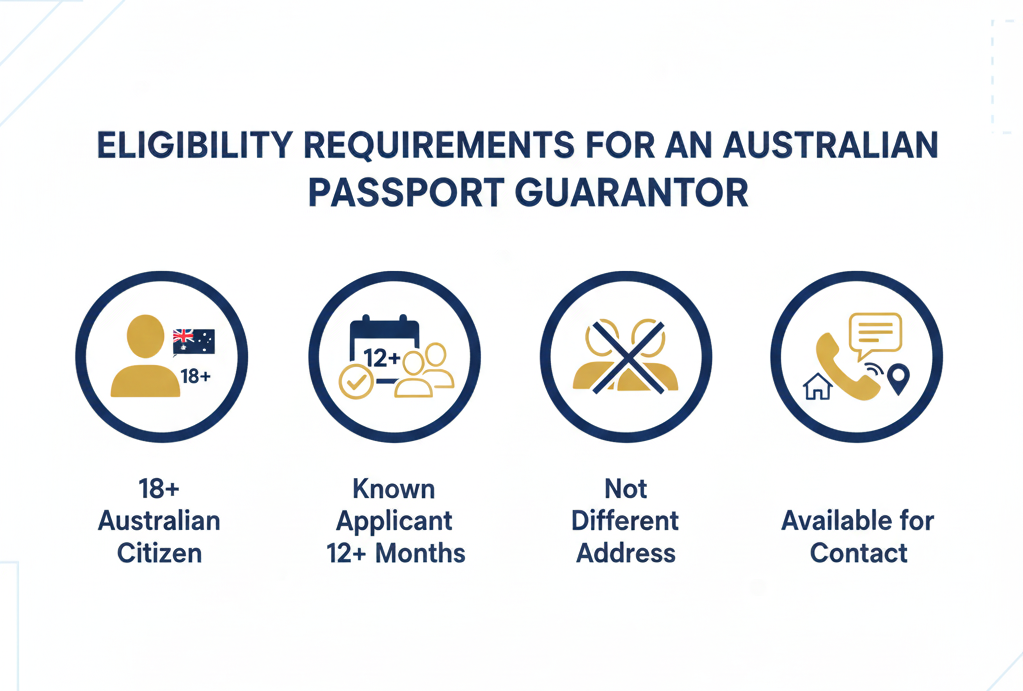
Regardless of their profession, every guarantor must meet the following fundamental criteria:
1
They must be 18 years of age or older, with no upper age limit. They must also be an Australian citizen.
Why it matters: It ensures the person has full legal capacity to act as a guarantor.
2
They must have known you personally for at least 12 months (or for children under one year, since birth).
Why it matters: The guarantor must genuinely know you and be able to vouch for your identity.
3
They cannot be related to you by birth, marriage or de facto relationship (including same-sex spouse/partner).
Why it matters: Ensures the guarantor is independent and objective.
4
They must not live at the same address as you. For child applications, the guarantor also must not live at the same address as the child or the child’s parents.
Why it matters: Again, this ensures independence; you’re not vouching for yourself through someone who lives with you.
5
They must be available during business hours, provide a daytime telephone number and be willing to confirm your identity if required.
Why it matters: The passport office may contact them to verify details, so they must be reachable.
Talk to one of our Visa Experts Now.
Your guarantor must qualify via one of two routes. They only need to meet one of them.
They must hold a current (unexpired) Australian passport, originally issued with at least two years’ validity.
Their passport does not need to have two years remaining today, but it must have been issued within the past 2 years.
Benefit: This is the most straightforward pathway for many guarantors and is the standard requirement for applicants applying within Australia.
If you are applying from overseas and cannot find an Australian citizen guarantor, you may use a non-Australian citizen who is currently employed in one of the approved occupations. For applicants in Australia, this pathway is generally restricted to Australian citizens who are on the electoral roll, though using a passport holder is strongly preferred and simpler.
Examples of approved occupations (typically for overseas applicants) include:
Important Note: Retired professionals generally do not qualify under this pathway unless they maintain their professional registration or have a current Australian passport.
Before asking someone to be your guarantor, run them through this list:
If any of the above are missing, it’s best to look for a different guarantor rather than risk delays.
Here’s what the guarantor is required to do, depending on whether you’re using an online or paper application:
For a paper application: Guarantor must sign Section 11 of your application form.
For an online application: You don’t need the physical signature/photo endorsement on a form, but you must nominate a guarantor (or referee) who agrees to act for you. They must be contactable and willing to verify your identity if the passport office calls or emails them.
There’s no cost to them, just clear responsibility. Make sure they understand what they’re vouching for.
Here are common missteps that lead to delays:
If your guarantor fails even one rule, your application may be delayed or rejected.
Sometimes people struggle to find a guarantor. Here are solutions:
In case of a real deadlock, we at Parish Patience Immigration Lawyers can be your guiding light through other available choices or even connect with you on difficult situations.

At Parish Patience Immigration Lawyers, our area of expertise lies in the field of Australian citizenship and passport-related issues. Our assistance includes:
If the guarantor part of your passport application is unclear, do not hesitate to book a consultation, as it is always better to get it right the first time than to experience delays.
Passport guarantor requirements might appear very serious and strict, but they can actually be considered straightforward when their implications are grasped. Properly selecting the guarantor, an adult over 18 years of age who has known the applicant for a minimum of one year, not a relative, lives apart, and either possesses a valid Australian passport or (for overseas applicants) is employed in an authorised occupation, makes it more likely for the application to go on without any problems.
If you have any questions regarding who can be a guarantor, what their roles are, or how to fill that section of the application, please feel free to get in touch with us at Parish Patience.
 Regional Visa Australia: Incentives & State Nomination Routes March 2, 2026
 485 Visa PTE Requirements: Meeting the English Test Criteria January 14, 2026
 How Do I Apply for an Australian Work Visa January 5, 2026
Our customers are always happy to share their thoughts with us.
Here is what some of them had said!

The team at parish Patience Immigration Lawyers were incredibly helpful throughout the application process. Their assistance made our lives so much less stressful and their expertise cleared up any confusion we had. They remained engaged with us the whole time and quickly responded to any questions with thoughtful, detailed answers. Special thanks to Usman Ali and Shan . We highly recommend the team at Parish patience immigration lawyer for anyone considering help regarding any kind of visa .
Highly recommended lawyers! Extremely professional and reliable service, with outstanding outcomes. A special thanks to Mr Thong and Marlene, for helping us with our difficult case. Not only did they ensure that everything was ready to go, but their professionalism came in favor when we were granted our visa within just under 6 months!
Thong and Marlene helped my partner gain permanent residency in Australia. We did the application ourselves but it turned out lots of information we needed to provide was missing. Thong and Marlene picked our case up and helped amend it. I really appreciate their help and guidance and look forward to contacting them again in the future. I am pleased by their efforts and professionalism.
Successfully handled my case. He had been prompt, caring and very professional in dealing with my case. I am glad to have received very strong support, guidance and service from them. I would highly recommend Parish patience immigration lawyers. I wish the best for their future prospects.
I’m really thankful for the guidance and assistance I’ve received regarding my Partner visa from Shan and his assistance Asha at Parish Patience. They handled my matter professionally and there were clear instructions from the beginning till end. I got my partner visa 820 granted in less than 7 months, thanks to their knowledge and expertise. I wish them all the best and highly recommend Parish Patience Immigration Lawyers for any sort of immigration matters.